
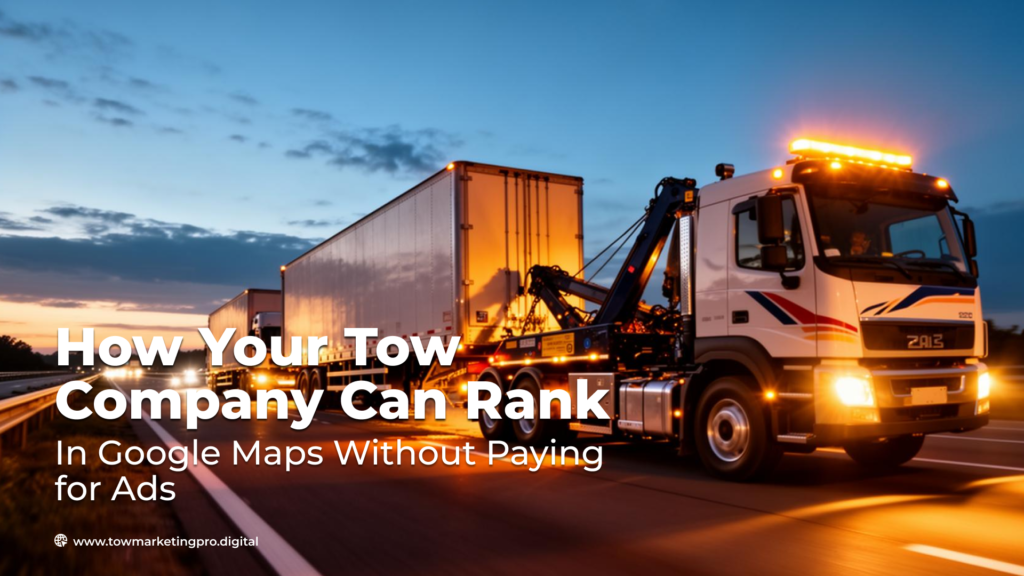
The three towing companies sitting at the top of Google Maps in your city right now are not all spending money on ads.
Some of them are. But a significant number of operators holding those top spots got there the same way every month: their Google Business Profile is optimized, active, and consistently signaling to Google that they are the most relevant and trustworthy option in that area.
This is the part of towing marketing that most operators either do not know about or have been told requires an agency retainer to manage. It does not. The core of Google Maps ranking is learnable, executable, and free to implement.
This guide breaks down exactly how it works in 2026, what Google is looking at, and what moves the needle versus what wastes your time.
Why Google Maps Matters More Than Your Website for Towing
Before we get into the mechanics, let us establish why this is worth your attention.
When someone searches “tow truck near me” or “emergency towing” on their phone, Google shows three results directly below a map. That section is called the Local Pack or the 3-Pack. It appears in 93% of local searches.
Here is what the data tells us:
44% of all local searchers click on a Local 3-Pack result. Only 8% scroll down to the organic listings below it.
The #1 position in the 3-Pack captures roughly 17.6% of all clicks on that search result page. Positions 2 and 3 capture 15.4% and 15.1%, respectively.
Together, the top three map results are absorbing almost half of all clicks before anyone touches a paid ad or an organic listing.
For towing, those numbers are likely even more concentrated because the search intent is emergency-level. A driver stranded on the side of a road is not scrolling. They see the first credible option, and they call.
If your towing company is not in the 3-Pack, you are not competing for the majority of emergency calls in your area.
That is not a marketing observation. That is a dispatch reality.
How Google Decides Who Gets in the 3-Pack
Google uses three core factors to determine which towing companies appear in the local map pack. Understanding these is the foundation of everything else in this guide.
Relevance is how well your profile matches what the person searched. Google looks at your business category, your service descriptions, the keywords in your profile, and how clearly you signal what you do and where you do it.
Proximity is how close your business location or service area is to the person searching. For towing, where you are physically located matters, but service area configuration on your GBP also influences how far your visibility extends.
Prominence is how established and trusted your business appears across the web. This is driven by your review volume and rating, how active your profile is, how consistent your business information is across every online directory, and how many other places your business is mentioned online.
Google does not publish an exact algorithm. But the 2026 Local Search Ranking Factors research from Whitespark and BrightLocal confirms: your primary GBP category is the number one factor for local pack visibility. Reviews account for approximately 20% of map pack ranking weight, the second highest category. Behavioral signals, including clicks, calls, direction requests, and profile activity, are rising fast.
Every tactic in this guide maps back to one of those three factors.
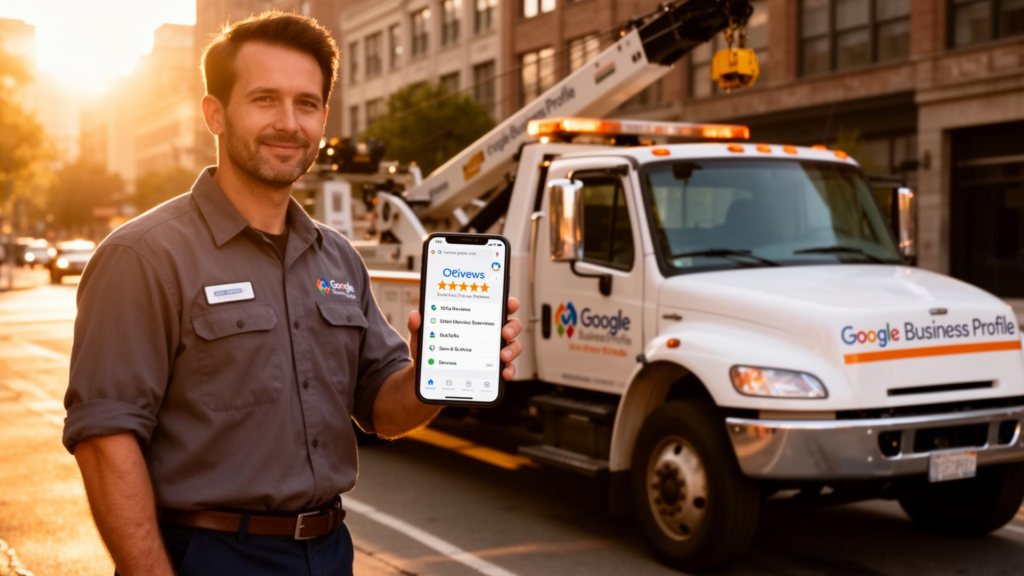
Step 1: Your Google Business Profile Is Either Working or Leaking
Most towing operators claim their GBP when they first open the business and never touch it again. That is the baseline mistake.
QUOTE:
A static GBP is a declining GBP. Google rewards profiles that look alive. An operator who set theirs up two years ago and has not updated it since is actively falling behind competitors who post updates weekly.
Here is what a complete, optimized GBP looks like for a towing company:
Primary category: “Towing Service” is the correct primary category. Not “Roadside Assistance” as the primary. Not a generic service category. Towing Service. This single setting has more impact on whether you appear for “tow truck near me” searches than almost anything else.
Secondary categories to add: Roadside Assistance Service, Auto Wrecker, Road Service.
Business description: 750 characters maximum. Use it fully. Include your service types, city, surrounding areas, and specific services. “Flatbed towing, wheel lift, roadside assistance, lockout service, jump starts, and winch-out services in [City], [City], and [City]. Available 24/7.” Write for the operator who is broken down at midnight, not for a marketing review.
Services section: List every individual service. Flatbed towing. Motorcycle towing. Heavy duty recovery. Winch-out. Lockout. Jump start. Tire change. Fuel delivery. Each one is a keyword signal. Most operators leave this section empty.
Hours: Keep them accurate. If you run 24/7, set it. If you have modified holiday hours, update them. Google now flags businesses as “may not be open” when hours appear stale or inconsistent with user feedback. That flag kills conversions.
Photos: Real truck photos only. Your actual fleet, your actual drivers, your actual jobs. Stock images damage trust with this audience. According to Google’s own data, profiles with photos receive 42% more direction requests and 35% more website clicks than those without. Upload new photos consistently, at minimum monthly.
Step 2: Reviews Are Ranking Fuel and Trust Signals at the Same Time
Here is the pattern most operators miss.
They think reviews are about reputation. Reviews are also about ranking.
Google treats review velocity, count, recency, and rating as direct signals for local pack position. A towing company with 80 reviews from the last six months will frequently outrank one with 200 reviews that stopped accumulating two years ago. Recent beats volume. Both beat nothing.
QUOTE:
The competitor ranking above you right now probably has fewer total reviews than you think. They just have more recent ones.
What a functional review system looks like for a towing operator:
After every completed job, the driver texts or verbally asks the customer to leave a Google review. A direct link to your review page makes this effortless. You do not need an app or a platform. A short URL that opens directly to your GBP review form is enough.
The ask matters. Customers who had a smooth, professional experience will leave a review if you ask directly. Most operators never ask. Their competitors do. That gap compounds every week.
Respond to every review. Positive and negative. Google’s 2026 data confirms that review responses signal engagement and management activity, both of which feed prominence. Your response to a negative review also shows every future customer reading it how you operate under pressure. That is trust-building at scale.
One more thing. Google removed over 170 million fake reviews in 2025, a 38% increase over the previous year. The algorithm is tightening. Do not pay for reviews. Do not use review pods. Build them through legitimate job follow-up. It is slower in the first month. It is permanent after that.
Step 3: Citation Consistency Is Silent and Critical
A citation is any online mention of your business name, address, and phone number. Every directory that lists your towing company is a citation: Yelp, Apple Maps, Bing, YP, Facebook, industry directories, local chamber listings.
Google cross-references these. When your name, address, and phone number are identical across every platform, Google trusts your data more. That trust translates directly into ranking strength.
When they are not identical, which is the default situation for most operators who never audited their listings, Google sees conflicting signals. Two different phone numbers. “St.” on one listing and “Street” on another. An old address from when you moved three years ago still active on Yelp. Each inconsistency weakens your local authority.
QUOTE:
You may have done everything else right on your GBP and be losing ranking position to a competitor who simply has cleaner citations. It is invisible. It is fixable.
The core directories to audit and correct for a towing company:
Google Business Profile, Yelp, Bing Places, Apple Business Connect, Facebook Business, YP.com, Foursquare, Angi, BBB, and any state or regional towing association directories your company is listed in.
The name on every listing must match exactly. The phone number must be the same. The address must be formatted identically. This is not exciting work. It is foundational work that directly affects how much Google trusts your business signal.
Step 4: Service Area Configuration Is How You Extend Your Reach
Towing is not a business where customers come to you. You go to them. That means the standard “storefront” setup on a GBP does not fully represent how your operation works.
Google allows service businesses to define a service area instead of or in addition to a physical address. For towing companies, this is a critical setting.
Your service area should reflect every city, neighborhood, and highway corridor you actually run calls on. Not an aspirational list. Your actual dispatch map.
When configured correctly, your GBP becomes eligible to appear in searches from those areas, not just the city where your lot is located. A towing company in a suburb can rank for searches happening five or ten miles away if the service area is set up to include those zones.
Most operators configure this once and never revisit it. If your coverage has expanded, if you added new territory, or if you have never set this up deliberately, this is a ranking opportunity sitting unclaimed.
Step 5: Google Posts Signal That You Are Open for Business
Google Posts are short updates you can publish directly to your GBP. They show up on your profile when someone views it in search results or on Google Maps.
The ranking impact of posts is not enormous on its own. But posts feed one of the fastest-rising ranking factors in 2026: behavioral and engagement signals. Google’s algorithm is actively looking for profiles that show consistent activity. Posts are a direct, controllable way to demonstrate that your business is operational, responsive, and current.
For towing operators, posts do not need to be elaborate. A quick update about summer breakdown preparation. A note about added service areas. A reminder about your 24/7 availability during a holiday weekend. Real-photo posts of completed recoveries, with permission.
Weekly posting is the standard. Monthly posting keeps the signal alive. Zero posts for two to three months is a negative signal in a competitive market.
The Factor Most Operators Do Not Know About: Behavioral Signals
This section matters more than most guides acknowledge.
Google is not just looking at what your profile says. It is looking at what people do when they interact with it.
How many people click your phone number directly from search results? How many request directions? How many click through to your website? How many people who see your listing in the 3-Pack actually choose you?
These behavioral signals feed into what Google calls “prominence.” A profile that shows consistent engagement, calls, clicks, direction requests, gets validated by user behavior as a real, active, and trusted business. That validation influences ranking.
QUOTE:
The competitor ranking above you is not just winning on paper. Real people are clicking their listing, calling their number, and getting their trucks dispatched. Google sees all of that. It counts.
This is why the full picture matters. Reviews drive trust, which drives clicks. Accurate hours mean callers actually reach you, which means completed transactions, which means more reviews. Photos of real trucks build credibility, which reduces bounce, which signals quality. Every element reinforces the others.
This is also why buying rankings through fake engagement or fake reviews is a diminishing strategy. Google’s systems are increasingly sophisticated at identifying artificial signals. The operators building sustainable 3-Pack presence in 2026 are doing it through legitimate profile activity, real reviews, and actual engagement.
What the 3-Pack Operators In Your Market Are Doing Differently
If you pulled up the top three towing results in your city right now and audited their GBP profiles, you would almost certainly find:
Correct primary category set to “Towing Service.” A populated services section with specific service types listed. Recent photos uploaded within the last 30 to 60 days. A review count that includes recent reviews from the last 30 to 90 days. A rating at or above 4.3 stars. A service area that covers their actual dispatch territory. And in most competitive markets, at least one Google Post in the last 30 days.
That is the baseline profile. None of it requires ad spend. All of it requires consistent attention.
The operators not in the 3-Pack typically have: the wrong primary category, an empty services section, photos from 2022 or earlier, reviews clustered in one period with nothing recent, and citation inconsistencies spread across the web.
The gap between those two profiles is not technical complexity. It is consistent execution over time.
Key Takeaways
- The Google Maps 3-Pack appears in 93% of local searches. 44% of local searchers click it. Only 8% scroll to organic results below it.
- Google ranks towing companies based on three factors: relevance, proximity, and prominence. Your GBP controls all three.
- “Towing Service” must be your primary GBP category. This is the single highest-impact setting on your profile.
- Reviews account for approximately 20% of local pack ranking weight. Review recency matters as much as total count.
- Citation inconsistencies across directories silently suppress your local ranking. Audit and standardize your NAP across every platform.
- Configure your service area to match your actual dispatch territory, not just your business address.
- Google Posts and regular profile activity feed behavioral signals that are rising in ranking importance in 2026.
- Behavioral signals, how many people click, call, and engage with your listing, are directly influencing local rank.
