


Most towing companies don’t struggle because they can’t tow.
They struggle because the phone doesn’t ring consistently.
Two companies can operate in the same city, run similar trucks, and offer the same services yet one stays busy while the other waits for work. The difference is rarely equipment or pricing. It’s usually a misunderstanding of how towing calls are actually generated in the United States.
Towing is not traditional marketing. It doesn’t follow the same logic as restaurants, retail, or home improvement. It runs on urgency, proximity, visibility, and operational readiness.
If you understand how those elements connect, call flow becomes predictable instead of random.
Every Towing Call Starts With Urgency
Towing is an emergency-driven service. That single fact changes everything about how marketing works.
When someone searches for a tow truck, they are usually dealing with stress. The car won’t start. They’re stuck on the roadside. They may be blocking traffic. They need help now.
In that moment, the customer is not researching brands. They are not reading long descriptions. They are not comparing five companies carefully.
They are looking for:
- Who is nearby
- Who looks reliable
- Who can answer the phone
The decision window is often under a minute.
This is why many traditional marketing strategies fail in towing. They are designed for industries where customers have time. Towing customers do not.
Why Mobile Search Drives Towing Demand
In the United States, most towing searches happen on mobile devices. That’s not just a statistic; it defines how calls are generated.
Mobile search behavior is fast and action-oriented. Users scroll quickly, glance at reviews, and tap call buttons directly from search results.
They don’t usually fill out forms. They don’t usually browse multiple pages. They want immediate connection.
This is why metrics like “website sessions” can be misleading in towing. A small number of high-intent mobile searches can produce more revenue than thousands of low-intent visitors.What matters is not traffic volume but being visible at the moment of need.
Where Towing Calls Actually Come From
Most towing companies receive calls from a limited number of sources. Understanding them clearly removes guesswork.
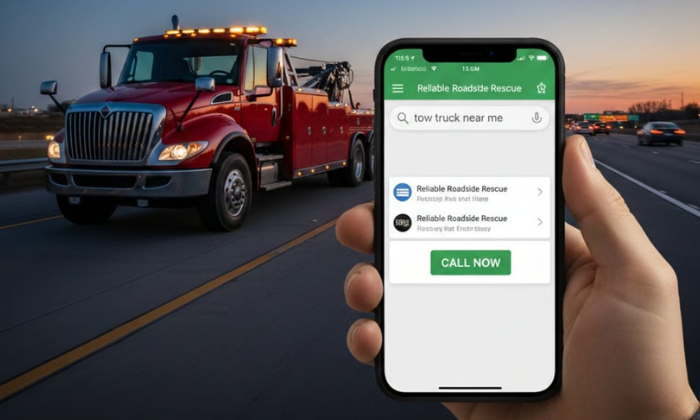
The largest driver of towing calls in most markets is Google Maps and the Local Pack. When someone searches for “tow truck near me,” Google displays nearby companies, their reviews, and a call button. Many users select directly from this screen without visiting a website.
- Organic search listings also contribute, especially in competitive markets where users scroll past the map. These listings support credibility but often play a secondary role.
- Paid ads can generate strong call volume, particularly in dense urban areas. However, they must be structured correctly. Ads built around clicks rather than calls often waste budget.
- Finally, reviews and reputation influence decisions across all channels. Even strong visibility won’t convert if trust signals are weak.
- Calls are rarely generated by one factor alone. They occur when visibility, trust, and accessibility align.
Why Google Maps Matters More Than Websites
Many towing companies assume their website is the primary engine of new business. In practice, Maps visibility often produces more calls.
Google Maps removes friction. It shows proximity, star ratings, business hours, and provides a direct call button. For someone stranded on the roadside, this is enough information to decide.
Websites still play a role, but it’s usually supportive. They confirm legitimacy and provide additional reassurance. They are rarely the starting point in an emergency.
A strong towing website should:
- Load quickly
- Display phone numbers prominently
- Clearly state service areas
- Be fully mobile optimized
It should not overwhelm users with excessive text or complicated navigation. In emergency services, simplicity converts.
How Paid Ads Generate or Waste Towing Calls
Paid advertising can accelerate call volume, but only when it respects the urgency of towing behavior.
High-performing campaigns focus on:
- High-intent keywords
- Geographic precision
- Direct call functionality
They minimize steps between search and phone connection.
Poorly structured campaigns often fail because they introduce friction. Sending users to slow landing pages, targeting broad informational keywords, or ignoring service-area boundaries leads to wasted budget.
Paid ads do not fix weak fundamentals. They amplify what already exists. If visibility and reputation are strong, ads can increase call flow. If not, they magnify inefficiencies.
Why Traffic and Rankings Don’t Guarantee Jobs
Many towing companies are told that increasing website traffic or ranking number one will solve their call problems.
In reality, those metrics can be deceptive.
Traffic without intent does not produce revenue. Ranking for a broad keyword does not ensure selection.
In towing, the most valuable searches are local, urgent, and specific. They may not generate large traffic numbers, but they convert at a high rate.
Additionally, ranking position is only one part of the equation. A company with slightly lower placement but stronger reviews and clearer availability often wins the call.
Vanity metrics do not pay invoices; Calls do.
The Real Impact of Reviews on Towing Calls
Reviews function as instant trust indicators.
In emergency situations, users rely on shortcuts. They don’t analyze deeply. They scan star ratings and glance at review counts.
A company with consistent, recent reviews signals reliability. One with outdated or sparse reviews creates hesitation.
It’s not just the rating that matters. Recency and response behavior also influence perception. Engaging professionally with reviews reinforces credibility.
In many markets, improving review quality and volume has a more direct impact on call conversion than marginal ranking improvements.

How Dispatch and Operations Determine Revenue
Marketing generates opportunity. Operations convert it.
Missed calls represent one of the largest hidden losses in towing businesses. In emergency services, customers rarely wait long for a callback. If a call isn’t answered promptly, they move on.
Operational gaps such as unclear service areas, inaccurate business hours, or slow response times directly reduce revenue.
There is also a feedback effect. Engagement signals such as answered calls and user interaction, influence search visibility over time.
Marketing and dispatch are not separate systems. They are connected. A breakdown in one weakens the other.
What Consistently Works for Towing Companies
Across different states and competition levels, successful towing companies share similar characteristics.
They maintain strong local visibility. Their business information is accurate and consistent. Their review profiles are healthy and active. Their phones are answered quickly. Their campaigns focus on high-intent searches rather than vanity metrics.
They don’t rely on one tactic. They align urgency, trust, and operations.
Advanced strategies can enhance results, but fundamentals drive stability.
Conclusion
“Towing calls are not random”.
They happen when a driver needs help, your company is visible, your reputation builds trust, and your phone is answered.
Understanding how towing companies actually get calls in the United States removes confusion and wasted effort. When urgency, visibility, and operational readiness align, call flow becomes more predictable.
Everything else in towing marketing builds on that foundation.
