

Your website is getting visitors. Google Analytics shows the numbers going up. But your phone is telling a different story.
This is one of the most common frustrations towing company owners across the US share with us. They invest in a website, sometimes in SEO or ads on top of it, and they can see the traffic coming in. But the calls per day barely move.
The problem is not your website. It is not your SEO provider either, at least not entirely. The problem is a fundamental mismatch between the kind of traffic being sent to your site and the kind of customer who actually dials a tow truck.
This article breaks down why that gap exists, what towing-specific customer behavior actually looks like in 2026, and what to focus on instead of chasing visitor counts.
How Towing Customers Actually Search
Most industries operate on a consideration cycle. A person thinks about a purchase, researches options over days or weeks, compares providers, then decides.
Towing does not work that way.
When someone needs a tow, the decision window is measured in minutes. They are on the side of a highway, in a parking lot, or stranded at 11 PM in an unfamiliar area. They are not browsing. They are not comparing. They are looking for the first credible option that shows up near them right now.
The searches that produce towing calls look like this:
- “tow truck near me”
- “emergency towing [city name]”
- “roadside assistance now”
- “car broke down [neighborhood]”
These are short, location-anchored, and urgent. They do not generate high traffic volume. A metropolitan area might have a few hundred of these searches per day. But every single one of them has someone on the other end ready to call the first operator they trust.
High-volume informational searches, the kind that SEO strategies typically target to build traffic, attract completely different visitors. People researching towing costs out of curiosity. People comparing companies with no current need. People outside your service area. None of those people are calling you tonight.
Why Traffic Numbers Go Up While Call Volume Stays Flat
Here is what happens when a towing company follows generic SEO advice.
The agency or tool recommends targeting higher-volume keywords. Those keywords are usually informational: “how much does a tow cost,” “types of towing services,” “what is roadside assistance.” These bring visitors. The numbers go up. The client sees a dashboard that looks like progress.
But those visitors were never going to call. They had no immediate need. Some were in the wrong city entirely.
Meanwhile, the searches that actually drive revenue, the hyper-local emergency searches, are low enough in volume that they do not look impressive on a report. So they get deprioritized.
This is why some towing companies with 500 monthly website visitors stay busier than competitors showing 5,000 visits. The 500 came from the right searches, in the right area, on mobile, at moments of need.
Traffic volume is a vanity metric for towing. Qualified call volume is the only metric that matters.
Where Most Towing Calls Actually Come From in 2026
Understanding where calls originate changes how you approach your entire marketing setup.
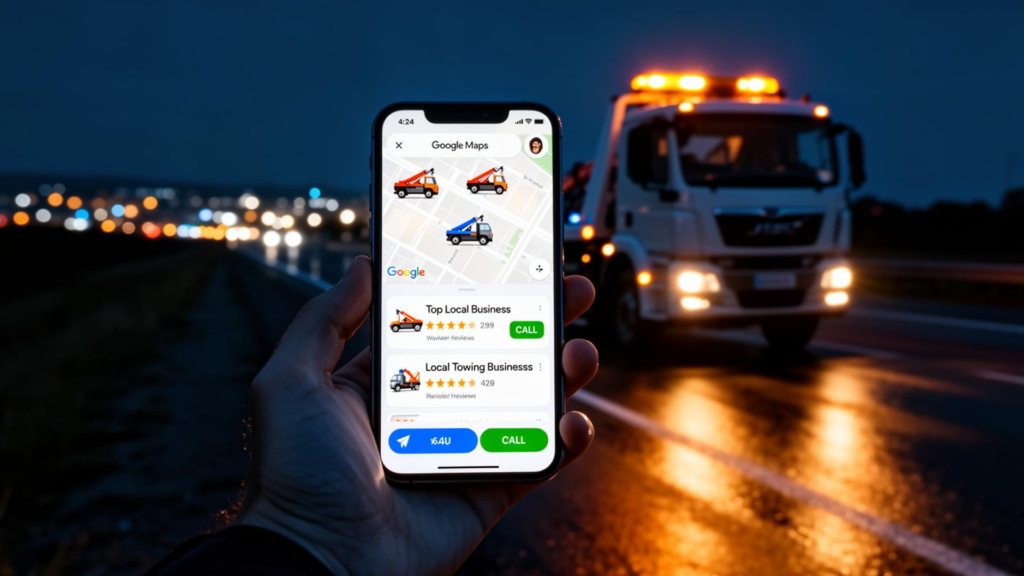
According to local search data, over 60% of local searches now result in a Google Maps interaction before a website is ever visited. For emergency services like towing, that number is likely higher. A driver searching for a tow truck sees the map pack, reads a few reviews, checks the star rating, and hits the call button. Your website never enters the picture.
This means two things:
First, your Google Business Profile is doing more work than your website during the critical moment of need. If your GBP is incomplete, has outdated hours, lacks service area information, or has not been updated recently, you are losing calls before anyone even considers clicking through to your site.
Second, website traffic metrics completely miss this call source. A customer who found you on Google Maps and called directly from there will not show up as a website visitor in your analytics. Your traffic report could be undercounting your actual inbound interest, and you would never know it.
Businesses in the Google Maps 3-Pack, the top three local results, receive dramatically more actions than those ranked below position three. That placement drives calls, direction requests, and clicks in a way that page-two organic rankings simply do not.
The Mobile Problem That Kills Towing Conversions
The majority of towing searches happen on mobile. This is not a trend. It is the baseline reality of emergency service searches. People do not go home, open a laptop, and research tow trucks. They pull out their phone in the moment.
If your website loads slowly on mobile, requires scrolling to find a phone number, or does not have a visible click-to-call button above the fold, you are creating friction at exactly the wrong moment. Emergency situations remove patience. A visitor who cannot figure out how to call you in five seconds will hit the back button and call the next result.
This is also why paid ads can fail for towing companies even when the click volume is good. Sending traffic to a slow-loading page, a contact form, or a generic homepage that requires navigation destroys the conversion. In emergency towing, the call button needs to be the first and most obvious thing on the page.
What Actually Drives Towing Calls
Once you understand how towing customers search and what happens before they ever reach your website, the strategy becomes much more specific.
Google Business Profile optimization is the foundation. Your GBP controls how you appear in the map pack, what reviews are visible, what your hours say, what service areas are listed, and whether your photos show a real tow truck. Every one of those elements influences whether someone calls you or the competitor below you.
Local keyword targeting over volume targeting. The keywords worth owning are not the ones with the highest search volume. They are the ones with emergency intent and local specificity. “Flatbed towing in [your city]” is worth more than “types of towing services” regardless of what any traffic report suggests.
Review velocity matters for ranking and conversion. Google Maps ranking factors include review count, recency, and rating. An operator with 80 recent reviews outranks one with 200 old reviews in many cases. Reviews also function as trust signals at the exact moment a potential customer is deciding who to call.
Call tracking, not just traffic tracking. If you are not tracking inbound calls and connecting them to their source, you are flying blind. You need to know whether your calls are coming from the map pack, from organic search, from a paid ad, or from a referral. Without that, you cannot make informed decisions about where to put your next marketing dollar.
Consistent NAP across directories. Your business name, address, and phone number need to be identical across Google, Yelp, Apple Maps, Bing, and every other directory your business is listed in. Inconsistencies weaken your local search authority and can suppress your ranking. This is invisible to most operators but actively hurts visibility.
When Website Traffic Does Matter for Towing
Traffic is not useless. It is just misunderstood.
Website visitors matter in towing when they meet three conditions: they are coming from within your service area, they are on mobile, and they land on a page that makes calling effortless. If all three are true, traffic converts. If any one of them is broken, traffic is just a number.
Traffic also supports trust during the consideration phase for non-emergency services. If you do heavy-duty recovery, commercial fleet accounts, or roadside assistance contracts, those customers do research before they call. For those service lines, content, credibility signals, and website quality matter more.
But for the bread-and-butter emergency towing call that most operators depend on, the website is often the second or third thing a customer sees, if they see it at all.
The Operators Staying Busy Without High Traffic
You will find towing companies in almost every market that have minimal website traffic, simple websites, and no active ads, but they stay booked.
They are not winning because of traffic. They are winning because:
They appear in the top three results when someone nearby searches for a tow. Their GBP is active, complete, and regularly updated. Their reviews are recent, specific, and numerous. Their phone number is accurate everywhere it appears online. And when someone calls, they answer.
Those fundamentals beat a high-traffic website almost every time in this industry.
The Right Question to Ask About Your Towing Marketing

Most operators ask: “How do I get more traffic?”
The question that actually produces more revenue is: “How do I get more qualified calls from people who need a tow right now, in my service area, and who will reach me when they call?”
That question leads you to your GBP, your local keyword targeting, your review system, your call tracking, and your mobile site speed. None of those show up on a traffic report. All of them show up on your dispatch sheet.
Traffic without intent is noise. Calls from the right area at the right moment are revenue. The two are not the same thing, and building a marketing strategy that confuses them is the most expensive mistake a towing company can make.
Key Takeaways
- Towing is an urgency-based service. The search intent that drives calls is fundamentally different from high-volume informational traffic.
- Over 60% of local searches lead to a Google Maps interaction before a website visit. Your GBP is often doing more work than your site.
- Businesses in the Google Maps 3-Pack receive dramatically more calls than those ranked below position three.
- Calls from the map pack do not appear as website traffic. Your analytics may be undercounting your actual inbound interest.
- Mobile load speed and a visible click-to-call button are conversion requirements, not nice-to-haves, for emergency towing searches.
- Track calls by source. Traffic metrics without call attribution tell you almost nothing about what is actually working.
